Showing posts with label smithsonian formula. Show all posts

Wednesday, January 5, 2011

Resources for Children


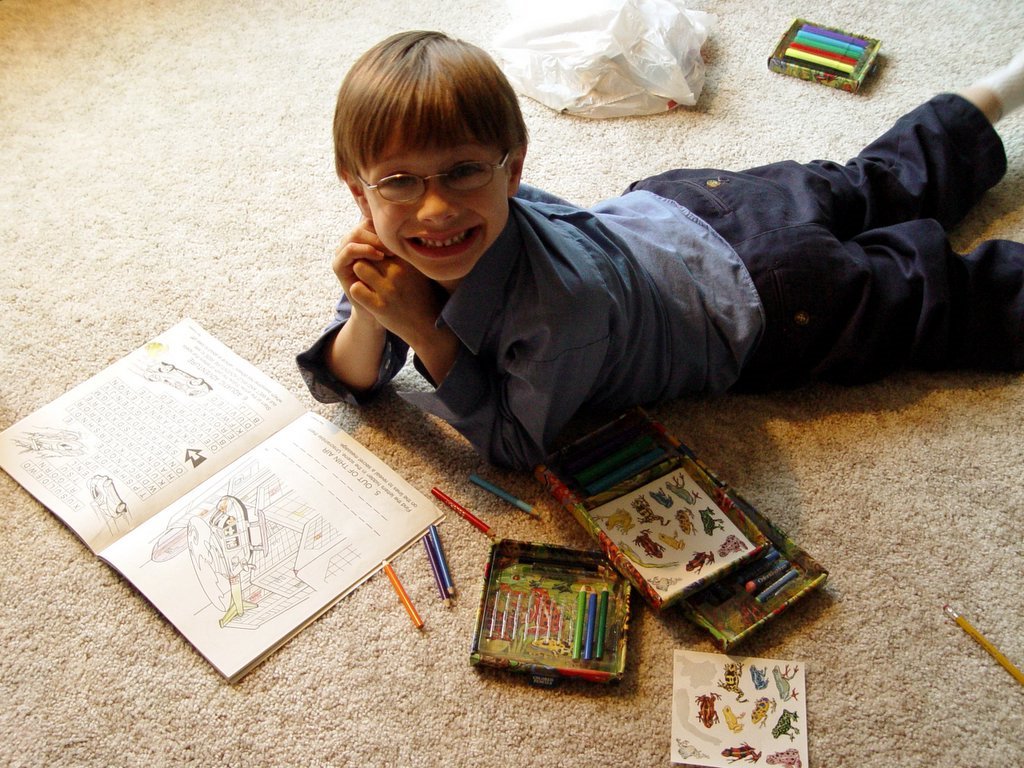
Oh, to be six again! Remember those days when paints, crayons, colored pencils, stickers, scissors, and glue provided you with hours of tranquility and fun? Life was good! Providing the ‘tools’ for a creativity is so important for children. Levi enjoyed a visit to our home recently. . .and we enjoyed observing the results of his efforts.  It is always interesting to see how each child develops uniquely when it comes to creativity. 

Is creativity something that can be taught?  Each reader may respond to this differently, but most would generally agree that creativity comes from within and is a quality that is innately possessed at birth.  Each child has potential, and if given the proper tools to develop it, wonderful, quirky, unique, and inventive works of art, song, or verse can result.  Many years ago I read a book about growing creative children.  I don’t remember the title or the author, but the principles were ones that became important in our homeschool.  The writer suggested that the best tools for creativity were simple resources (paper, pen or pencil, keyboard, cardboard, glue, paint, crayons, glitter, feathers, sequins, crayons, etc.).  It was her belief that there were always to be available to the child.   She went on to say that the time and freedom to explore and create with these resources was  key.  This was not a subject taught in school, but rather an opportunity that took place during a child’s free time each day.  When resources are available to the child, the creative activities they participate in become child-directed and meaningful to them.  Exercises that involved coloring within the lines or copying existing art may assist the child in developing fine motor skills, but they do not foster creativity in a child.  In the same way, a child who learns at an early age to think of their own sentence or story to write on a page, rather than assigned copywork that a teacher-parent chooses, learns not only to develop and improve their handwriting, but to become a thinker rather than a reflector of  the assignments or thought of others.  Why be satisfied with bringing a child up to grade level when he or she can reach for the height of imagination and artistic, musical, or written creativity?


This is a good time to review the Smithsonian Institute’s study of the factors that world-class geniuses experienced as they learned and developed their intellects.  I believe that these factors not only develop great thinkers, but creative ones as well.  Do you remember them from a previous post?  The key factors are:

1) warm, loving, educationally responsive parents and other adults;
2) scant association outside the family, and
3) a great deal of creative freedom under parental guidance to explore their ideas.

Dr. Raymond Moore, in his book Better Late Than Early, makes a statement that ties this subject altogether for us.  As the “grandfather of homeschooling”, I believe he was a very wise man.  I love this quote from him:

“Children are happiest when they are busy, and keeping them busy should not be a matter of concern.  Much of a child’s busyness will be accomplished on his own.  Much of it will come from the child’s questions and curiosity.  The parent’s goal should be to respond to the child’s questions in a patient, consistent and constructive way.  Forget about the pressures of achieving.  Cultivate the idea of being happily child centered, for the child is important.  Take advantage of his motivation of the moment.  Be happy that he is curious, and try to go along with his curiosities whenever you can”  [page 21].

Give your child the resources he or she needs.  They need the tools to create — free time, materials, and affirming support.  Try to cultivate a child-centered approach.  And take advantage of a child’s natural curiosity.  Creativity is always sure to result when the formula is implemented.  Allow the child to think outside of the box and stand-by to see the exciting results!

Friday, November 5, 2010

Giving Children the Freedom to Explore


The third element of the Smithsonian Institute formula for creating a genius is to provide the child with freedom to explore.  Allowing children to grow and develop naturally creates a relaxed and less pressured environment, thereby allowing them to use their creativity and curiosity as they explore the world around them and find things that interest them.  By contrast, the hurried child frequently is pushed to learn on a schedule, get things done within external parameters, and to skim the top of schoolwork rather than to comprehend it in-depth.  This can result in children becoming delayed and burned out.  The home educator can facilitate brain development and intellect by creating an environment that gives the child time and resources to explore the things that interest them most.  A wise parent-teacher observes and regards these things and enhances the learning process by expanding upon them as they facilitate learning in their child.  There are a variety of techniques that can be used to accomplish learning by this free and organic method of instruction.  Time is a vital element in this approach.  Children need time to touch, taste, feel, hear, and smell life as it goes on around them.  Distractions like electronic gadgets and television should be eliminated from their day so that they can learn by exploring their world.  There are moments when the child needs time alone to create and learn about things around him or her, but the presence of a parent who is willing to create and explore things with the child enhances the process.  Our time with them is as important as their time alone.  Creating art, listening to music, acting in charades, building with blocks, walking in nature, or cooking in the kitchen are ways in which children and parents can explore and interact together.  Resources for exploration, like art supplies, books and magazines, objects from nature, manipulative learning resources, musical instruments, and concrete materials like wood, nails, and a hammer should be abundant and available to the child.  As the child develops and grows, the parent can observe trends and interests, creating learning opportunities that amplify the learning process.  Creating great spaces of time for the freedom to explore is vital in the growth and development of an intelligent child.  A less hurried child is a child who learns faster, more thoroughly, and with less pressure.  Learning is enhanced by the simple gift of freedom to explore.

More Time with Parents than Peers


Homeschool parents are probably asked about socialization more than any other topic related to educating their children.  Our culture has led us to believe that children need to be around peers in order to have good social skills, and that this process needs to start at a very young age.  Daycare centers and preschools are filled to capacity with children whose parents believe they are doing what is best for their kids.  So, when a family chooses to home educate, well-meaning grandparents, neighbors, and even strangers question their decision.  But, if we consider the second point given in the Smithsonian Institute study on raising genius children, we realize that cultural beliefs are not necessarily accurate.  The Smithsonian study found that the children who developed the highest quotient of intelligence were those who were virtually isolated from children outside of their family.  If children spend more time with their parents than with their peers, positive socialization takes place.  When a family works together, plays together, studies together, and serves others together, children tend to have fewer mental or emotional problems and are more likely to be free of peer dependency.  A study reported in Kid’s Stuff magazine found that children taught at home do not lag in social development.  The study indicated that home taught children have consistently fewer behavioral problems.  Instead of being negatively socialized by their peers, the children who were home educated depended more upon adult contact and less with contacts with other children, resulting in well-adjusted and well-behaved children.  Why?  Because they tended to imitate their parents.  Imagine that!  Not only do children who spend more time with adults than peers have the opportunity to have a higher IQ, but they are more socially adjusted as well.

Applying Your Homeschool Philosophy


An educational philosophy is important for your home school. If you have a home school philosophy that is specific to your family it helps to keep your goals and strategies in focus. The grandfather of home schooling, Dr. Raymond Moore, recommends that each family have a philosophy written and prepared as the basis of establishing a curriculum for each family that home schools. A successful family philosophy focuses HIGHLY upon the formula that Dr. Moore presents (Smithsonian formula) on creating a genius.

The Smithsonian Institution’s study of twenty world-class geniuses stresses three factors: 

1) warm, loving, educationally responsive parents and other adults;
2) scant association outside the family, and
3) a great deal of creative freedom under parental guidance to explore their ideas.

Peer pressure works to tell us that we must socialize our children by having them spend time with other kids. But, studies have shown that the greatest socialization takes place within the family structure and by association with other adults. It is perfectly okay for children to spend all week with their parents, associating with other children only weekly at church. As children reached the upper elementary grades, they frequently start asking for opportunities to spend with other children. At that point, teaming with other friends to start a ‘home school activity group’ that meets semi-monthly and provides structured field trips for a group of local, home school children can be provided. This frequently fills the ‘need’ of children to associate with others their age. Piano and other group lessons can also help meet this need. The structured environment continues to facilitate learning and prevents an opportunity for negative socialization.

A great deal of freedom to explore is important. In order to create creative children, time and resources to work with are essential. So is the ability for mother or father to put up with a mess! A separate space for learning can be helpful in containing materials for this type of exploration. Paper, glue, paste, scissors, computer printers, cameras, film, paint, glitter, etc. and etc. are much more important than coloring books and paint by numbers. A supply of art materials should always been readily available at all times. They are tools that can be utilized for every subject, not just art class.

It’s important to keep priorities in focus. If one chooses to home-educate, then the education of our children must be a priority. This includes their religious education and the development of their intellect and ability to think for themselves. This comes before: canning and freezing food; laundry; a clean house; shopping trips; visiting the neighbor; etc. Of course these other things are important — but the children and their education should come first. Assigning workbook pages for the children so that the parent has time to wash windows or clean the oven does not create a wholesome and productive school environment. Children become bored to tears and homeschooling can become a struggle with this approach. Instead, plan work into the daily routine, so the children work with the parent in establishing a tidy home structure. Make this process a part of learning. Then, continue to develop other kinds of learning events as a family team. Although it is important for a child to learn to work independently, busy work is not the key.

Lessons learned while creating, building, analyzing, and applying concepts are best absorbed and retained by children. A unit study approach that is developed by the parent teacher around the interests of the children being taught is interesting and grasped well by them. It is the role of the teacher parent to create lessons and learning experiences that spark the interest in the children being taught. A bored child does not learn well. It is the parents role to provide experiences that facilitate growth, learning, and interest in any subject. Mastery will result effortlessly if this principle is applied.


Developing an educational philosophy assists the home school family to teach and learn purposefully. Once a philosophy of learning is established, the resources selected to facilitate this learning fall into place. If workbooks do not play a role in promoting your educational philosophy, there is no need to spend money on them! Instead, use your resources to find the tools that promote the philosophy you choose to embrace. Children are a precious natural resource. Thoughtful care should be taken in establishing how we will help them learn.

Achieving Optimal Intellect


Dr. Shinichi Suzuki, the influential teacher of the Suzuki method of music education, spoke frequently of the ability that all children have to learn things well if they were placed in the right environment.  His motto is “any child can learn”.  His methods, though sometimes controversial, make sense to me.  Expanding his concepts to areas beyond music opens the door to new concepts in education.  Believing that any child can achieve optimal intellect, I embarked on a journey to explore ways to help my own children become thinkers and not mere reflectors of the thoughts of others.  As a public school teacher, I knew that some students learned to think, but many who crossed my path were simply satisfied with becoming cookie-cutter students; ones who followed the crowd and interacted and learned just like their peers.  It seemed that if I put my own children through the same process as the norm, the risk of developing reflectors rather than thinkers was great.  During the discovery process, I came across a simple formula for creating children who knew how to think, create, and excel and I was hooked!  This formula was developed by Harold McCurdy and his team of researchers.  They were commissioned by the Smithsonian Institute to discover the recipe for the creation of genius’ throughout history.  The results of their research revealed simple and amazing principles that any parent can implement in their homeschool.  Would you like to know the formula?  Here it is:  1)  provide the child with warm, responsive parents and other significant adults in their life, 2) isolate the child from peers outside of their immediate family, and 3) give the child much freedom to explore and follow their own interests.  Although simple, this formula goes against much of what current culture believes and endorses for raising intelligent children.  But, when these principles are not present, or are only minimally present in the lives of children, it is found to suppress the development of his or her intellect.  Would you like to raise children who can think?  Consider the formula for raising a genius!