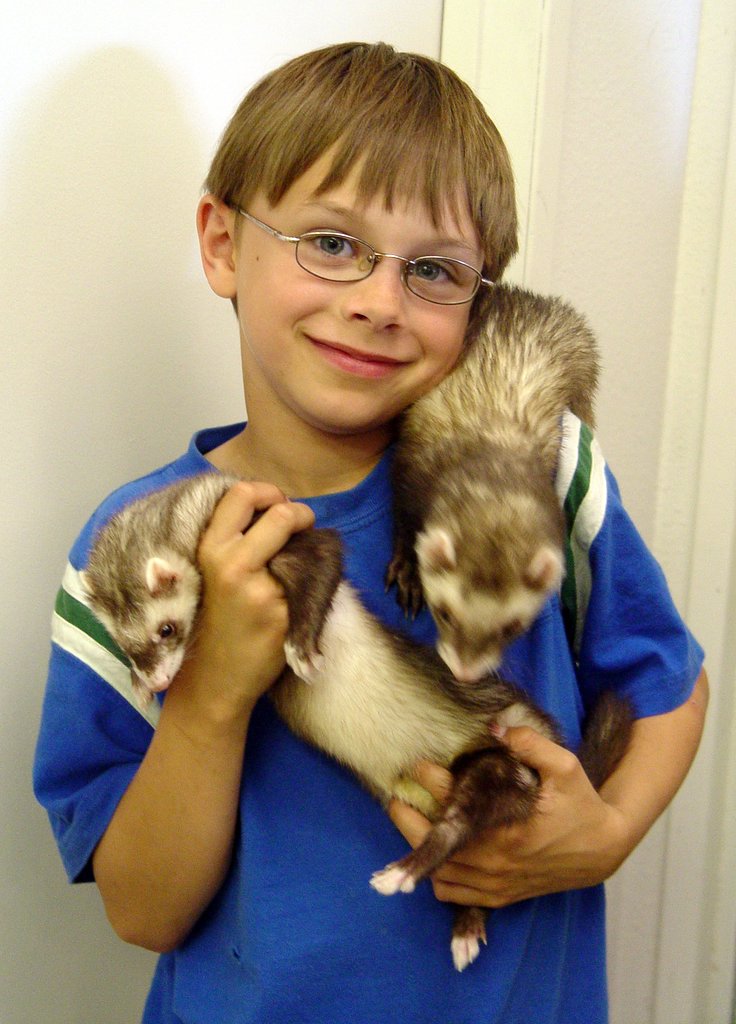
Animals are an essential part of the homeschool! The interactions a child has with animals can teach many things: responsibility, compassion, nurture, and care. The bond between animal and child can be very strong. It provides an opportunity for character development as well as the study of God's creation.
We've been 'ferret-sitting' for Levi while he went on a camping trip with his mom and dad. Alice and Sid were exciting guests! When in their cages, they look and act so serene, sleeping in their hammocks or cuddling in their pocket-beds. But, once their cage doors are opened, they are energy PLUS! They scamper, romp, and attack imaginary enemies! Corners, crevices, and far-away places are favorites of theirs! Sid got into the sub-woofer of one of our computer speakers! He'd crawled into a funnel-shaped hole and we weren't sure he could get back out again. But, some gentle coaxing resulted in an innocent face eventually poking out of the hole and the energetic furry ensued again once he was out. Both ferrets love to attack feet! It was a funny sight to see the young adults in our home sitting on chairs with their feet tucked under them or perched on a countertop!
Do you have animals as a part of your homeschool?
Showing posts with label science. Show all posts
Thursday, May 29, 2014
Tuesday, May 27, 2014
Creating a Nature Journal
Spring is a wonderful time for exploring nature! Most homeschool teacher-parents realize the importance of nature as they study with their children. It teaches so many things — of science, art, ecology, physical education, observation skills, and of God’s care. With thoughtful attention, even math, history, language arts can be taught in nature. Treasure and scavenger hunts in the back yard support observation skills and mathematics if designed properly. And there’s no better way for a primary age child to learn how to write the alphabet than with a stick in the sand. Following famous footsteps, like hiking along the Oregon Trail, combine nature with history. A well-prepared parent will be full of stories to share as the hike progresses. Nature provides many opportunities for a teacher-parent to create mini unit studies that enhance learning. It doesn’t need to be difficult or complicated. Try putting together a one-day unit study that uses nature as the classroom and teaches across the curriculum. You will be sure to have the interest of all ages! And after a long winter of dreary days, spring is the perfect time to implement this.
Keeping a nature journal or notebook is an easy way to tie everything together. I like the idea of using both to implement nature studies. A small journal with both lined and unlined pages works to write sentences and paragraphs about things observed. The blank pages work great for sketching, watercolor, or chalk drawings. And a notebook works great for quick notes and for collections. Gallon size zip-lock bags, punched with a three-hole punch, make pages. Using twelve gives students one for each month of the year. Page dividers, marked January through December, give the child a place to put notebook paper, their zip-lock bag for that month, and handouts from their teacher-parent that might be helpful in their nature study. Mini field guides, diagrams of the parts of trees or flowers, or scanned photos of birds, animals, or bugs give them guidelines as they search and identify in the outdoors. Plants and leaves gathered can be brought home to press and dry, and later can be glued or taped to notebook pages and marked according to identifying parts. A story could even be written about the objects in the notebook or about the events leading up to gathering what is shown. Scripture can be quoted and copied as it pertains to things seen or gathered. Handwriting practiced. A camera that takes photos that can be downloaded into a computer and then printed and put in a notebook is a great way for a child to document and learn. There are no age limits! From preschool through adulthood, this is a learning adventure that encompasses all ages! Creative, active, and enriching, a nature notebook is a fun way to enjoy God’s creation and apply it to everyday learning and lifestyle.
Friday, September 30, 2011
Teaching Across the Curriculum
Use your time in the kitchen to teach across the curriculum. Relate what the child is doing to arithmetic, reading, science, and geography. Guided questioning is very helpful in expanding your child's field of knowledge.
Here is an example:
1) Have the child prepare Navajo Fry Bread (recipe below) and then answer the questions given.
2) Why do you think this is called Navajo Fry Bread? Look on a map and find where the Navajo Indians live.
3) Why did you use oil in the skillet when you fried your Navajo Fry Bread?
4) Describe how the dough felt when you kneaded it. Use as many different adjectives as you can think of to describe it.
5) What kind of shapes did you cut your Indian Fry Bread into? Which shape did you like best? Why?
RECIPE
Navajo Fry Bread
Mix together these ingredients (use a small bowl):
- 1/2 cup white flour
- 1/2 cup whole wheat flour
- 1 tsp. sugar
- 1/4 tsp. salt
- 1/2 tsp. baking powder
In another small bowl mix together:
- 4 Tbsp. flour mixture
- 2 Tbsp. warm water
After the flour mixture and warm water is mixed together, take it out of the bowl and place it on a floured cutting board.
Knead the dough until it is soft and like elastic.
Roll it out so that it is flat. Use a rolling pin.
Cut the dough into shapes using a biscuit cutter and table knife.
Pour a small amount of oil into a skillet. Heat over medium-high heat. Put your dough shape in the skillet and fry each side until golden brown.
Take your dough shape out of the skillet. Blot it with a clean paper towel.
Fry another dough shape until all the shapes are fried.
Serve your Navajo Fry bread with honey while it is still warm.
Labels:
kids cooking,
language arts,
nutrition,
science,
social studies,
unit study
Monday, September 12, 2011
A Nature Guessing Game
September is a wonderful month for nature projects and activities. The weather is conducive to exploration and plants and trees are mature and starting to seed. A nature guessing game can include the outdoors and is fun for all ages.
Give each person in a group a grocery bag. Label each one with a different number on the outside. Be sure the grocery bag is not opaque, because you don't want people to be able to see shapes or shadows of what's inside. Have everyone go outside for a walk in the woods, a park, or the back yard. Each person is to find and gather five different items that they find. Make sure they don't collect live things, but other nature objects instead. Things to look for could be pinecones, leaves, rocks, seeds, seed pods, an acorn, a feather, a stick, fallen pine needles, and more. Set a timer for 15 minutes and then have everyone return to a central location.
When everyone has returned, have them sit in a large circle. Give each person a pencil and paper. Have each person pass their bag to the person on their right. Allow them one minute to feel what's inside the bag, guess what it is, and write the names of the items in the bag on their paper. Make sure they write the bag number on the paper along with the names of the objects.
Then, continue with the next person's bag and so on, with individuals writing the names of objects guessed on their paper.
After all the bags have been explored, have each person show the items in their bag and tell about it. As they do this, everyone should check their papers to see how correct they were.
Although this game is very simple, it is fun, entertaining, and educational for all ages!
Sunday, May 22, 2011
Lessons from Nature
Spring and summer is a wonderful time to study nature with children. Picking spring flowers, taking hikes on the hillsides, throwing rocks in a creek, or enjoying newborn animals are opportunities that the season provides. Each nature experience provides the teacher-parent with object lessons and opportunities to teach lessons in character development, science, applied arts, and more.
Today's post shares a story about baby goslings. Do your children like pets and cool dip in a pond on a warm summer day? If they do, this story will be of interest to them. It teaches about responsibility and love for God's little creatures. It's about baby goslings and a young boy's responsibility to care for them.
Wednesday, May 4, 2011
Making a Crystal Garden
There are many kinds of gardens, and some of them don't require plants. Making a crystal garden using household items can be a fun science project for children. Here's how:
1 aluminum pie pan
5 pieces of plain charcoal (untreated)
6 Tbsp. water
1 Tbsp. ammonia
6 Tbsp. bluing (a laundry product)
6 Tbsp. salt
a few drops of food coloring
Mix the ammonia, water, salt, and bluing in a glass bowl or jar. Place charcoal in the pie pan. Pour the liquid mixture over the charcoal. Dot with the food coloring. Use a variety of colors if desired. Place in a dry place and watch it grow!
Friday, April 22, 2011
Wildflowers of God's Creation
Spring has arrived in North America. In the cooler areas, spring wildflowers are just starting to show their beautiful faces. On trips to the mountains and forests, hillsides of yellow lupine, lavender phlox, and yellow dog-tooth violets can be seen. It won’t be long until shooting stars and Calypso lady slipper orchids appear in secluded spots. Finding them is like a treasure hunt that a person never tires from. Each year it is exciting to find the first bloom from these special plants. Wandering hillsides and meadows in search for wildflowers is fun without any tools, but if one has a zip-lock bag or field guide, samples of wildflowers can be gathered or identified for more fun and interesting activities. Adding some water to a zip-lock bag of flowers keeps them fresh until home again where they can be put into a vase to enjoy for a few days. Pressing wildflowers between the pages of a catalog and using them to decorate rolled beeswax candles or to glue to a card is a creative way to display wildflowers for months to come. Identifying flowers is an art that can take some time and research. If a regional field guide of wildflowers is used the task can be completed in the field, but sometimes using the Internet is easier. The flowers kept fresh in a zip-lock bag can be used to compare with images found online and descriptions compared with the wildflower in hand.
As the art of flower identification is explored, interesting discoveries can be made. Sometimes plants are not named with common sense! When discoveries are made that appear inconsistent, time spent in study of how plants are classified can result in families spending time together in the rewarding task of being “plant detectives”. Clues from nature lead the observer through the steps of identification and tell stories of why things are named as they are. For example, right now the dog-tooth violets and the yellow violets can be found growing near one another in forest meadows and woods. Both have the name ‘violet’, yet the differ vastly from one another. One is an actual violet, and the other belongs to a different family altogether! The real name of the dog-tooth violet is Erythronium and it received its name because it grows from a bulb that looks like a dog tooth. On the other hand, the yellow violet really does belong to the Viola family, and is therefore accurately described as a violet. Starting with one picked flower like a dog-tooth violet can direct the the explorer to another flower like the violet, and that can lead to other interesting discoveries about plant families and other facts of nature as the thread of learning continues. Learning about wildflowers by observation and discovery is fun and an interesting way to observe God’s creation!
Subscribe to:
Posts (Atom)