Showing posts with label Moore Formula. Show all posts

Saturday, July 20, 2013

Homeschool Formula


As a new school year starts for many, it seems timely to review the core "recipe" for homeschooling. I have always appreciated the one by Dr. Raymond and Dorothy Moore, early advocates of home education. Here's their recipe for home-school teaching:

"The requirements are not complex. Parents need only to be loving, responsive, and reasonably consistent, and salt these qualities with a little imagination, common sense, and willingness to follow a few simple suggestions...And don't worry about the opinions of neighbors who don't know or care about the real needs of children. Just be kind to them. Have your children be helpful in your home and in the neighborhood. Visit the old and infirm and ill. Do favors for others without asking any in return. Soon your 'strange antics' will be forgotten...or admired." 

They remind us that:

  • "In one sense you are teaching all your waking moments --- as models to your offspring. Yet while some parents are more diligent than others, none need to formally teach a full school day."

And continue with this:

  • "Much more important is your working with your children in physical work, helping them learn practical skills and the nobility of work --- building character qualities of initiative, industry, neatness, order, responsibility, and dependability, which are hard to find in even one of ten children or young adults today."

And there's more!

  • "Along with these grosser values you can by precept and example teach manners and graces which today are rare --- kindness, thoughtfulness, tact, forgiveness, generosity, and a just plain kind of for-others love. This is seldom done in schools these days. Teach therm how to walk tall, how to listen closely, how to speak graciously. Paul was not gesturing idly when he wrote Philippians 4:8, 'Finally, brethren, whatsoever things are true, whatsoever things are pure, whatsoever things are lovely, whatsoever things are of good report;...think on these things.'"

Using the Moore Formula of work, study, and service, children have been found to excel academically and socially. For more on this subject, it's recommended that you establish your foundation and philosophy for homeschooling by reading several of the books Raymond and Dorothy Moore have written on homeschooling. 

The quotes above are from the book "Home-Spun Schools" page 12 - 13.

Thursday, September 6, 2012

Teaching is Inspiring, Motivating, and Inducing


"Teaching is inspiring a student rather than filling him with facts. It is responding to him rather than demanding of him. It is motivating him to explore on his own rather than controlling his explorations. It is inducing him to think, rather than repeating others' thoughts. Teaching is leading others to be like you --- and more. It is finding lessons in everything you see, hear, smell, taste, and touch, and bringing them together to give deeper meaning and fulfillment to life." 

Dr. Raymond Moore
Home-Style Teaching, A Handbook for Parents and Teachers

Wednesday, September 5, 2012

Recipe for Home Teaching


As a new school year starts for many, it seems timely to review the core "recipe" for homeschooling. I have always appreciated the one by Dr. Raymond and Dorothy Moore, early advocates of home education. Here's their recipe for home-school teaching:

"The requirements are not complex. Parents need only to be loving, responsive, and reasonably consistent, and salt these qualities with a little imagination, common sense, and willingness to follow a few simple suggestions...And don't worry about the opinions of neighbors who don't know or care about the real needs of children. Just be kind to them. Have your children be helpful in your home and in the neighborhood. Visit the old and infirm and ill. Do favors for others without asking any in return. Soon your 'strange antics' will be forgotten...or admired." 


They remind us that:


  • "In one sense you are teaching all your waking moments --- as models to your offspring. Yet while some parents are more diligent than others, none need to formally teach a full school day."


And continue with this:


  • "Much more important is your working with your children in physical work, helping them learn practical skills and the nobility of work --- building character qualities of initiative, industry, neatness, order, responsibility, and dependability, which are hard to find in even one of ten children or young adults today."

And there's more!

  • "Along with these grosser values you can by precept and example teach manners and graces which today are rare --- kindness, thoughtfulness, tact, forgiveness, generosity, and a just plain kind of for-others love. This is seldom done in schools these days. Teach therm how to walk tall, how to listen closely, how to speak graciously. Paul was not gesturing idly when he wrote Philippians 4:8, 'Finally, brethren, whatsoever things are true, whatsoever things are pure, whatsoever things are lovely, whatsoever things are of good report;...think on these things.'"


Using the Moore Formula of work, study, and service
, children have been found to excel academically and socially. For more on this subject, it's recommended that you establish your foundation and philosophy for homeschooling by reading several of the books Raymond and Dorothy Moore have written on homeschooling. 


The quotes above are from the book "Home-Spun Schools" page 12 - 13.


Tuesday, May 3, 2011

Being Happily Child Centered


Without professional training, simply by being herself, a concerned, loving mother usually can do more for her normal child than a teacher can.


Parents should, of course, be willing to learn new ideas.  But a mother need not be a trained teacher, nor does she need to teach in any formal way.


By using the framework of everyday home activities in a practical way, she can help her child learn as much as possible about the things around him.


The parents goal should be to respond to the child's questions in a patient, consistent and constructive way.  Forget about the pressures of achieving.


Cultivate the idea of being happily child centered, for the child is important.  Take advantage of his motivation of the moment.  Be happy that he is curious, and try to go along with his curiosities whenever you can.

Dr. Raymond Moore
Better Late Than Early, page 21

Saturday, April 2, 2011

Moore on Home Education


One of my favorite books on the subject of home education is Home Grown Kids, written by the grandfather of homeschooling in America, Dr. Raymond Moore.  In it he shares a way of thinking that was radical when he wrote the book thirty-some years ago!  Homeschooling, now considered a "right", was a "privilege" that was hard earned in its early stages.  He encouraged parents to embrace the right and responsibility of homeschooling.  Here's a quote from his book that reinforces this concept.

"No schoolroom can match the simplicity and power of the home in providing three-dimensional, firsthand education. The school, not the home, is the substitute, and its highest function is to complement the family. The family is still the social base, and must be, if our society is to survive. Let's leave no stone unturned to guarantee the fullest freedom of the home and the rights of parents to determine the education of their children."

Dr. Raymond Moore
Home Grown Kids page 26

Wednesday, March 2, 2011

Freedom to Learn


Adults believe that freedom is an inherent right. At the same time, some adults believe that they are the keepers of their children and should be able to control them and tell them exactly what to do. There may be some merit in that way of thinking, but for children to grow and thrive, they need some degree of freedom and flexibility as well. This allows them to grow naturally and achieve much. The Moore Formula approach to learning teaches that within parental guidance and love, giving children the freedom to follow their creative instincts in work, study, and play allows them to find their own inventive genius! And that no one knows better than the teacher-parent where a child’s natural curiosity leads and what their interests are. Taking this journey of exploration together, as parent and child, is an opportunity that when implemented will be one that will be without regret. 

For more on this subject: Home School Burnout, Raymond and Dorothy Moore – Chapter 1

Sunday, February 27, 2011

Applying Work, Study, & Service


 Applying the study, work, and service method of home education can require that a parent-teacher think outside of the box.  Most people think of schoolwork, textbooks, copywork, and the three R’s when they think of a home-school curriculum.  But, the development of the intellectual is only one facet of education.  When combined with work and service, the academic aspects of home-schooling become one-third of a whole.  In the beginning it takes effort and concentration to figure out exactly how to apply study, work and service.  It is generally recommended that each aspect receives equal time.  Planning purposefully to achieve this goal is essential, although there is room for an ebb and flow on scheduling.   Over time it becomes easier and how it is applied becomes natural and unique to each family.

A formula that works well for any homeschool where the whole child is being developed is:


100% study
100% work
100% service


Children should be encouraged to experience life purposefully. They should be encouraged to learn and given time and freedom to explore. They are to give it their all. If they are deep in a subject and interested, they should not asked to stop learning because their time is up.  Decide early on that it is a mistake to halt or stunt a child’s learning.

The children should be encouraged to work each day. Routine chores should happen daily and occur each morning and night teach children life skills. As the children grow older, study melds its way into gainful work as they apply their education to skills that earn them money during their teens. The dividing line becomes blurred. They should always be encouraged to do their best work.

The children should be encouraged to be compassionate and to always think of others. Service can be something done as a planned event, but mostly should become a way of life — thinking of  family members, friends, neighbors, and others around the world. It can be mixed with study (writing a note to a shut-in or drawing a picture for a sick child) — or service, by keeping a continuous prayer and praise journal during family devotionals each day — or work, in a grandparents or neighbors yard in an effort to serve them because they were not able to.

Each one of these traits blends with the other and together they create a whole. One some days, more time can be spent in study, while on others more time spent on work or service. During our homeschool years, I first kept notations in my plan book (study, work, or service) but over time, as it became a part of our life learning, it became organic and just happened because of habit and inculcation into the thinking of us all. It becomes easier over time. In the initial stages of applying the formula for study,work, and service, it is important to be purposeful about implementing all three aspects of the program.

Planning each segment of the whole creates a home-school where study, work, and service becomes an integral part of learning and the creation of the whole child

Saturday, January 8, 2011

Implementing the Moore Formula


The Moore Formula recommends a relaxed and natural style for homeschooling. Dr. Raymond Moore was an advocate of the homeschool, and discouraged teaching by the creation of a school at home. His approach incorporates children into the daily tasks of life, with a great deal of interaction between parent and child all day long. Learning tasks are selected purposefully, but approached casually and with fun. Basic skills are integrated and reinforced through games, verbal interaction with the parent, and by application. Academics are limited to one or two hours a day, even at the upper grade levels. According to Moore, “much of the day is framed around the children’s interests with work and service that builds genuine golden-rule citizens and successful entrepreneurs” [Home School Burnout p. 13].  His method encourages that children be allowed to grow as naturally as possible, with a guidance and discipline that promotes discipleship and self-control. [Ibid p. 13] His method incorporates a four-point formula which can be used by anyone dealing with the education of children. This informal approach to learning involves having the child spend as little time in formal education as possible. This includes eliminating conventional homework. Instead, children are encouraged to work with parents in family industries and in church or with non-school organizations like 4-H, Scouts, or hospital volunteers. Family time, playing games and learning skill building which capitalizes on writing, singing, and learning math facts, is encouraged as a positive and happy time. Programs like Math-It and Winston Grammar are helpful tools for accomplishing this. Scary? Yes, but possible? Absolutely! It has been proven over and over again that children not only learn and keep up with their peers by this approach, but thrive and surpass them in the long run. Additionally, children who’s parents approach learning by this approach do not suffer from educational burn-out and apathy. The Moore approach can be used successfully not only in the early elementary years, but through all through elementary and high school years. It is sometimes difficult for parents to break out of the box of traditional educational expectations, but once done success is key!

Wednesday, January 5, 2011

The Alphabet of Christian Experience

The development of character is an important facet of creating a child who is whole and emotionally healthy.  As a homeschool parent, it is important to not only help the child develop intellect through study, and a work ethic by giving opportunities for both useful and gainful employment, but an altruistic spirit by creating opportunities for service to others. Children from tots to teens can purposefully serve others, bringing joy to others lives, and growing beautiful hearts at the same time.  Service to others should be a family focus and an part of every homeschool plan.  Dr. Raymond Moore, sometimes called the grandfather of homeschooling, says that “when united with the heart, the head and hand move out in selfless service to others.  There is no discipline formula that can match this experience of work and service”  [Home School Burnout p. 135].

Implementing work and service into a homeschool program is sometimes called the ‘study, work, and service’ formula.  Applying the ‘study, work, and service’ method of home education can require that a parent-teacher think outside of the box.  Most people think of schoolwork, textbooks, copywork, and the three R’s when they think of a homeschool curriculum.  But, the development of the intellectual is only one facet of education.  When combined with work and service, the academic aspects of homeschooling become one-third of a whole.  In the beginning it takes effort and concentration to figure out exactly how to apply ‘study, work and service’.  It is generally recommended that each aspect receive equal time. Planning purposefully to achieve this goal is essential, although there is room for an ebb and flow in scheduling.   Over time it becomes easier and how it is applied becomes natural and unique to each family.


Writer, E. White, speaks of service to others as being a meaningful experience.  She says that “a company of believers. . .may do a work in the home, the neighborhood, the church, and even in ‘the regions beyond’, whose results will be as far-reaching as eternity.”  A few paragraphs later, she applies this principle specifically to the young, saying that “it is because this work is neglected that so many young disciples never advance beyond the mere alphabet of Christian experience”  [Desire of Ages p. 640].  How appropriate that she compares service to the alphabet of Christian experience.  Just as study teaches children the alphabet of academics, Christ’s alphabet reaches farther and deeper, shaping hearts and hands for eternity.

Even as the Son of man came not to be ministered unto, but to minister — so should we, by example and instruction.  Everyone is needed, both young and old.  Together as families we can develop a finishing spirit and see a job well done.

Resources for Children


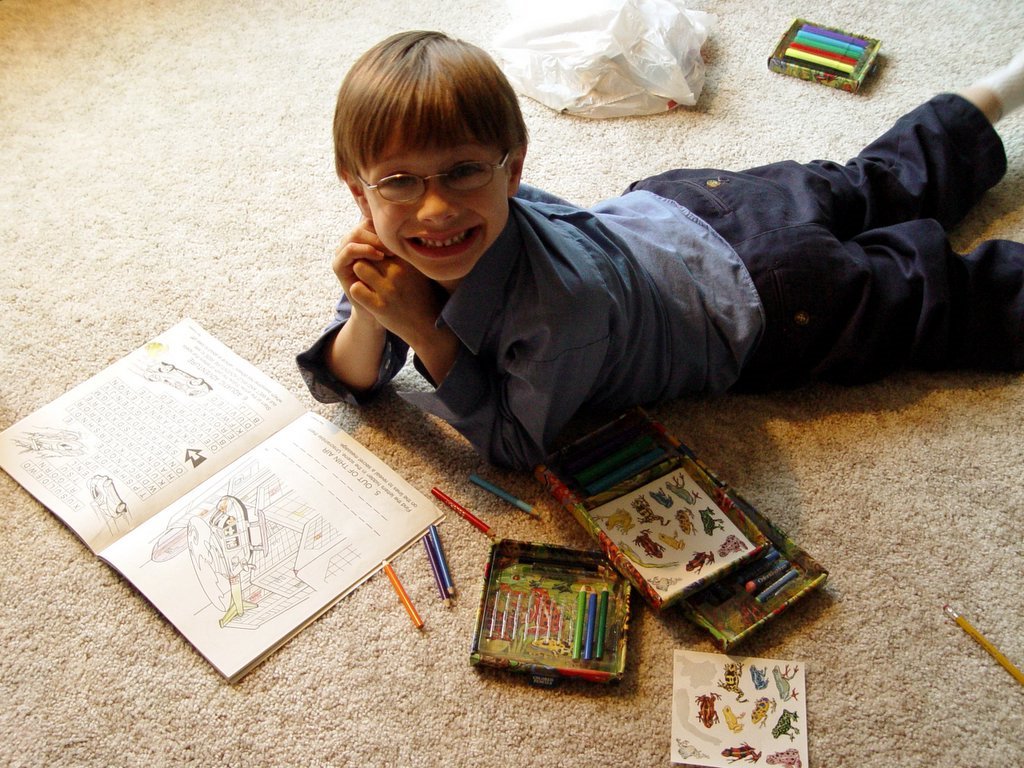
Oh, to be six again! Remember those days when paints, crayons, colored pencils, stickers, scissors, and glue provided you with hours of tranquility and fun? Life was good! Providing the ‘tools’ for a creativity is so important for children. Levi enjoyed a visit to our home recently. . .and we enjoyed observing the results of his efforts.  It is always interesting to see how each child develops uniquely when it comes to creativity. 

Is creativity something that can be taught?  Each reader may respond to this differently, but most would generally agree that creativity comes from within and is a quality that is innately possessed at birth.  Each child has potential, and if given the proper tools to develop it, wonderful, quirky, unique, and inventive works of art, song, or verse can result.  Many years ago I read a book about growing creative children.  I don’t remember the title or the author, but the principles were ones that became important in our homeschool.  The writer suggested that the best tools for creativity were simple resources (paper, pen or pencil, keyboard, cardboard, glue, paint, crayons, glitter, feathers, sequins, crayons, etc.).  It was her belief that there were always to be available to the child.   She went on to say that the time and freedom to explore and create with these resources was  key.  This was not a subject taught in school, but rather an opportunity that took place during a child’s free time each day.  When resources are available to the child, the creative activities they participate in become child-directed and meaningful to them.  Exercises that involved coloring within the lines or copying existing art may assist the child in developing fine motor skills, but they do not foster creativity in a child.  In the same way, a child who learns at an early age to think of their own sentence or story to write on a page, rather than assigned copywork that a teacher-parent chooses, learns not only to develop and improve their handwriting, but to become a thinker rather than a reflector of  the assignments or thought of others.  Why be satisfied with bringing a child up to grade level when he or she can reach for the height of imagination and artistic, musical, or written creativity?


This is a good time to review the Smithsonian Institute’s study of the factors that world-class geniuses experienced as they learned and developed their intellects.  I believe that these factors not only develop great thinkers, but creative ones as well.  Do you remember them from a previous post?  The key factors are:

1) warm, loving, educationally responsive parents and other adults;
2) scant association outside the family, and
3) a great deal of creative freedom under parental guidance to explore their ideas.

Dr. Raymond Moore, in his book Better Late Than Early, makes a statement that ties this subject altogether for us.  As the “grandfather of homeschooling”, I believe he was a very wise man.  I love this quote from him:

“Children are happiest when they are busy, and keeping them busy should not be a matter of concern.  Much of a child’s busyness will be accomplished on his own.  Much of it will come from the child’s questions and curiosity.  The parent’s goal should be to respond to the child’s questions in a patient, consistent and constructive way.  Forget about the pressures of achieving.  Cultivate the idea of being happily child centered, for the child is important.  Take advantage of his motivation of the moment.  Be happy that he is curious, and try to go along with his curiosities whenever you can”  [page 21].

Give your child the resources he or she needs.  They need the tools to create — free time, materials, and affirming support.  Try to cultivate a child-centered approach.  And take advantage of a child’s natural curiosity.  Creativity is always sure to result when the formula is implemented.  Allow the child to think outside of the box and stand-by to see the exciting results!

Friday, November 5, 2010

Hand-Made and Customized Education


“True home schooling is tutorial, hand-made, customized to each child. Such parents respond to their children in a loving, informal way, a balance between systematic structure where needed and a great deal of freedom for youngsters to explore.”
 
~ Raymond S. Moore

Piaget, Advocate of Delayed Academics


Jean Piaget was a Swiss psychologist and philosopher who studied children from birth through adolescence. He lived from 1896 through 1980 and was influential among educators for decades. He was known for many things, but possibly the best for his theory of cognitive development and the way he advocated for delayed academic studies. His research forms the foundation of educational method that some specialists have built upon in the development of their own educational theories. Dr. Raymond Moore, the ‘grandfather of homeschooling’ in America, and his belief in delayed academic learning is one example of someone who used Piaget’s theories in the development of their educational theory.

Piaget believed that the way children processed cognitive thinking was different than that of youth and adults. He studied children by several methods. One was by researching and charting standardized test scores. Another was by studying his own three children and recording how they developed from birth through to adulthood. He observed children through all ages and stages, both in a learning environment, at work, and home.

His ultimate conclusion was that all children develop in stages and that each one will exhibit very distinct and certain patterns of cognition in each period of their growth and development. These patterns can be recognized as sequential and predictable for each age. He identified four developmental stages. As his theory advocates, they are: 

1) Sensorimotor stage (birth to age 2)

A this stage a child learns through sensation and movement. It is important that they experience touch, smell, taste, hearing, and things to see (colors, shapes, and faces). It is also important that they observe and experience movement at this age. Rocking a child is vitally important during this phase of development. At this stage, children are extremely self-centered and cannot see the perceive the world through the eyes of another. They let their needs be known by crying and requiring immediate attention. 

2) Preoperational stage (ages 2 – 7)

At this stage, a child cannot use logical thinking. These years are sometimes known as the years of magical thinking. Children from two to seven are beginning to master symbols such as language and are starting to be able to form conclusions based upon past experiences. Although initially egocentric at this age, this trait weakens as they grow older. During this stage of development, children are developing their motor skills. It is important to allow opportunity and experiences for this growth, and to not rush a child onto the next stage before mastery of motor skills is achieved.

3) Concrete operational stage (ages 7 – 12)

Children of this age are very concrete in their thinking. In fact, their thinking is limited to concrete experiences. They learn to generalize by drawing conclusions about one situation and applying it to another. As they mature through this stage, they begin to think logically, but that thinking is still very concrete in nature and with practical tools to assist them. Children at this age are no longer ego-centric. 

4) Formal operational stage (ages 12 – adult)

Children in this stage can now deal with abstractions, mental speculation, and the formation of hypotheses. Abstract reasoning occurs and they are able to think logically. They can keep watch or maintain in their thought processes. Abstract reasoning opens up the world of thinking to children at this stage.

The rate or speed of passing through these phases may vary, but the sequence of stages is consistent for all children. When choosing or designing curriculum for children, the method and materials should match the cognitive level of the child. It is important that these principles are applied to how a parent-teacher chooses to home educate the children in their care so that natural, purposeful, and successful learning can result. Rushing a child through one stage to the next can be counter-productive and effectively cause burn-out and learning difficulties for the child. From the studies of Jean Piaget we can conclude that it really is ‘better late than early’ when it comes to academic instruction.

Developmental Psychologist Promotes Delayed Academics


It might seem unusual to mention Dr. Raymond Moore [1916 - 2007] in a listing of educational leaders in history, but his influence upon home education was significant. He has sometimes been called the “grandfather” of homeschooling in America. As a developmental psychologist, his views of education were an application of his research and the opinions of famous educators and/or writers like Piaget, Holt, Elkind, and White. According to the publisher of many of the books he authored, he was successful in bringing together the major disciplines of early learning — the brain, the senses, reason, and social-emotional development — in a way that was both organized and workable. His educational method formed an applied approach to a unique and successful formula for home education. As an early pioneer in the homeschool movement, it was through his influence and effort that homeschooling became legal in all fifty states. He developed what is know as the “Moore Formula” which customized an educational approach to a child’s interests, abilities, and aptitudes. Instead of workbooks or copywork, he emphasized the unit study or projects, both of which facilitated higher levels of learning. His approach advocated an equal time spent in study, work, and service. He was a proponent of delayed academics, even for home education, encouraging parents to delay formal academics until children are 8, 10, even 12 years of age. His research and anecdotal records of successful homeschool families who have used it prove that his approach produces children who are enthusiastic about learning and who have reduced levels of burn-out when compared to children who are traditionally schooled. Students taught using the Moore Formula have been shown to be independent thinkers and strong leaders. They test well academically and are sought after by higher institutions of learning because they are not burned out and are enthusiastic about learning. The service aspects of the Moore approach succeed in developing selfless traits and strong characters. Although the philosophy of Dr. Raymond Moore and the way it is applied to educating students is unique and many time opposes traditional thought regarding education, the result of students schooled with his approach to learning show superior and significant results.


Books authored by Dr. Raymond Moore and his wife, Dorothy are:

Home Spun Schools
Home Style Teaching
Home Grown Kids
Homemade Health
Homebuilt Discipline
Better Late Than Early
School Can Wait
The Successful Homeschool Family Handbook


Most of these books are available on Amazon.com.