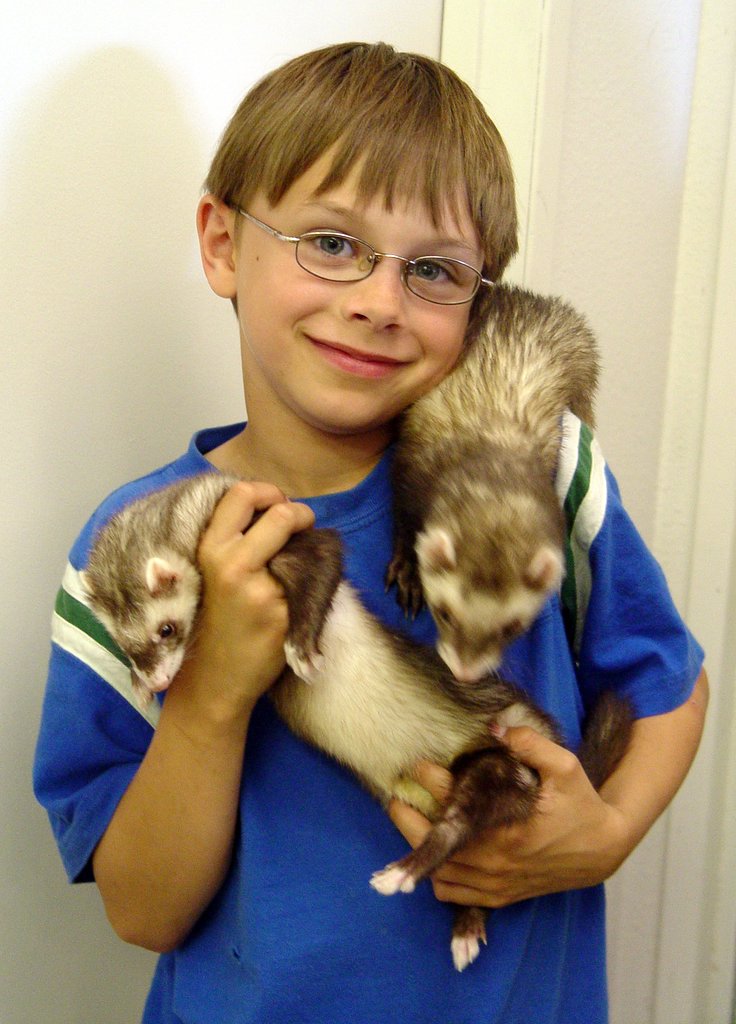
Animals are an essential part of the homeschool! The interactions a child has with animals can teach many things: responsibility, compassion, nurture, and care. The bond between animal and child can be very strong. It provides an opportunity for character development as well as the study of God's creation.
We've been 'ferret-sitting' for Levi while he went on a camping trip with his mom and dad. Alice and Sid were exciting guests! When in their cages, they look and act so serene, sleeping in their hammocks or cuddling in their pocket-beds. But, once their cage doors are opened, they are energy PLUS! They scamper, romp, and attack imaginary enemies! Corners, crevices, and far-away places are favorites of theirs! Sid got into the sub-woofer of one of our computer speakers! He'd crawled into a funnel-shaped hole and we weren't sure he could get back out again. But, some gentle coaxing resulted in an innocent face eventually poking out of the hole and the energetic furry ensued again once he was out. Both ferrets love to attack feet! It was a funny sight to see the young adults in our home sitting on chairs with their feet tucked under them or perched on a countertop!
Do you have animals as a part of your homeschool?
Showing posts with label character development. Show all posts
Thursday, May 29, 2014
Monday, May 19, 2014
A Student's Math Worksheet
On the inside cabinet door in our study area I’ve taped up bits and pieces of information that have inspired me throughout our homeschool years. Poetry, an encouraging note, a verse from scripture, drawings the children made, and photos of special activities all take up this space. This is one poem that found its way inside our cupboard door:
A Student’s Math Worksheet
- This school year is like a Math worksheet
- The Master has handed to you.
- The four basic functions are needed,
- In the work you are given to do.
- Some problems require addition
- Of diligence, virtue, and faith.
- And some of them call for subtraction
- Of laziness, carelessness, hate.
- For choosing the right in decisions,
- Division you’ll need to employ.
- Make good use of multiplication,
- With cheerfulness, kindness, and joy.
- Check over your work and be accurate;
- Small errors affect the whole sheet.
- And guard against streaks of indifference,
- Or splotches of ugly conceit.
- What note do you think will the Master
- Inscribe when the school year is gone;
- On your sheet: ”Unsatisfactory”,
- Or will He write, “Very Well Done”?
Author Unknown
Saturday, April 5, 2014
Lessons Learned from Observing Birds
This is a post written by my Aunt Evie in which she shares lessons that she has gleaned by observing birds. Her article can be used as a mini unit study, encompassing the subjects of character development and science. Character qualities are shown below in italics and are linked to a description of the character quality being discussed. Each type of bird discussed is linked to a page that tells shares a picture, habitat, and qualities of the bird. These can be shared with children and discussed while reading Aunt Evie’s story. To add language arts to this bird unit study, lists of spelling words can be created from this post and writing assignments given. To include art, assign sketching or watercolor projects of the birds discussed. An energetic bird watching hike fits into the subject of physical education. I hope you enjoy her thoughts.
Just as the Bible uses many chapters, all different so God’s second book also has many chapters, and each one is full of character building lessons for those who look for them. One of my favorite chapters deals with birds and I would like to share a few of the lessons they have taught me.
From the common robins I have learned diligence. Early in the spring while other birds are just flitting about choosing nesting sites and going through their courting antics, the robins are busily building their nests. They have no time for nonsense! They are the first ones up in the morning and the last to retire at night. Their sturdy mud and grass nest is quickly finished. By the time most of the other birds have settled down to start making their nests, the robin’s babies are almost ready to fly.
In the killdeer I have observed courage and perseverance. One hot day in late spring I watched a brave little mother killdeer standing over her eggs which were laid among the rocks on the edge of a sunny parking lot. There was no need to sit on her eggs to keep them warm. Instead, she stood beside them to shade them from the burning sun Cars came and went on the lot but she would not leave her eggs. Even when I walked up to her nest to look at the eggs, she stayed at her post of duty, though she was obviously upset by my nearness.
The lovely cedar waxwings have taught me refinement and good taste. They do not go in for flashy colors like some birds do, but in their quiet way they are as beautiful as any of the more showy birds. Every feather is always sleek and perfectly groomed and their soft conservative colors look so neat and smart. Their voices are as gentle and harmonious as their colors, and their family life seems to go on without any scrapping or fussing, They will sometimes sit side by side on a branch and pass berries to one another.
From the beautiful yellow warbler, I learned something about the meaning of this text from God’s first book. “Be not overcome of evil, but overcome evil with good.” A pair of these sweet singing birds had just nicely finished building their nest when along came a mother cowbird and aid an egg in it. She expected that her egg would hatch before the yellow warblers eggs did and then her larger baby would crowd the others out and get all the food. Many little birds are thus forced to raise baby cowbirds which are bigger than themselves, instead of raising their own babies. But the yellow warblers have found a way to overcome this problem. I once found a very interesting nest that showed me how they do it. It seemed to be a very deep nest but when I began to take it apart, I found that it was three stories high and the first and second stories each had a large speckled egg in them. The cowbird had laid her egg in the first nest and the warblers had simply built another nest over top of the first one, covering the unwanted egg. Then the persistent cowbird had returned and laid another egg in the second nest. But the yellow warblers still did not give up. They built a third nest over the second one and laid their eggs in it. How often we try to do right only to find that something spoils all our plans Can be learn from these little birds to keep on trying and “overcome evil with good”? Next time someone spoils something you were trying to do, see if you can find a way to overcome evil with good.
Patience was the lesson that an Oregon junco taught me one summer day. He was just getting ready to take a nice refreshing dip in our bird bath when an old robin hopped in and started splashing around. Since the pool was not big enough for two, the junco flew to a nearby rock and patiently waited his turn. The robin took his time, splashing and splashing, then just when at least he seemed to be finished he started all over again. he took so long that the patient junco finally fell asleep while he was waiting. Still the robin continued to splash. At last he flew to a branch to preen himself, but the junco did not notice he was too sound asleep. Suddenly, with a start, he woke up and seeing the pool empty at last he hopped in for his long delayed bath.
A western wood pewee once taught me a very striking lesson: dare to be different. I watched him taking a bath at the edge of a lovely wooded lake. But he was not content to just wade into the water and splash around like other birds do. He had a style all his own. From the top of a post at the waters edge, he darted at the water, hitting it a glancing blow with his chest, just before he swooped upward again. Water splashed in every direction as he struck it. he repeated this several times until he was thoroughly wet, then he settled on the post to preen himself. Sometimes we need to have the courage to be different, not just for the sake of being different, but because it is the right thing to do.
Last but not least, I have learned from my pet chickadees. They have taught me to trust. Birds generally do not trust anyone. Especially do they fear the human hand. It could close on them and take away their freedom and to a wild bird, freedom means more than any delicacy. But chickadees can be taught to be more trusting. As I held out to them my hand, filled with seeds, I thought of how our heavenly Father holds out his hands to us and calls us to come to Him. But we are so afraid that He might take away our freedom to do what we want to do, that we refuse to trust Him. But the chickadees learned one winter day that they could trust and eat from my hand and still be free. In fact, they were more free than ever. The rich food that I was offering them kept them warmer and better nourished than the meager food that they were finding for themselves and they did not have to work so hard to try to survive in the cold. So it is with us. If we will learn to trust our heavenly Father we will find more real freedom and satisfaction than we ever thought possible.
In an Audubon’s Nature Encyclopedia I found an interesting note about chickadees. It said that if you want to find birds in the wintertime, listen for chickadees. They have an air of confidence about them that leads other birds to follow them. I have found this to be very true. Wherever there is a band of chickadees, there will usually be other birds close by.
Those who learn to trust also develop an unconscious air of confidence in God that leads others to follow them. Would you like to lead others to your heavenly Father? Then first learn to trust and eat fro His hand, and your life will attract others and you will be able to teach them to trust your God. “And he saith unto them, Follow me, and I will make you fishers of men”. Matthew 4:19.
To continue this study, click here.
Copyright EvelynS@2014
Thursday, July 25, 2013
Consistency
"Children are unpredictable. You never know what inconsistency they're going to catch you in next."
Franklin P. Jones
Friday, June 10, 2011
A Spiritual Garden
First, plant six rows of peas:
Pardon
Patience
Preparedness
Promptness
Politeness
Perseverance
Then plant four rows of squash:
Squash criticism
Squash gossip
Squash laziness
Squash indifference
Next plant six rows of lettuce:
Let us be faithful
Let us be loyal
Let us be unselfish
Let us be truthful
Let us love one another
Let us read our Bible
No garden is complete without turnips:
Turn up with a smile
Turn up with a testimony
Turn up with a real concern
Turn up with a willing spirit
Turn up with encouragement
Planting instructions:
Plow the furrows of the heart deeply and water daily with the tears of heartfelt prayer. Note: due to the ideal climate in which we live, these seeds can be planted at any time of the year. Plant where they are exposed to the Son.
Author unknown
Pardon
Patience
Preparedness
Promptness
Politeness
Perseverance
Then plant four rows of squash:
Squash criticism
Squash gossip
Squash laziness
Squash indifference
Next plant six rows of lettuce:
Let us be faithful
Let us be loyal
Let us be unselfish
Let us be truthful
Let us love one another
Let us read our Bible
No garden is complete without turnips:
Turn up with a smile
Turn up with a testimony
Turn up with a real concern
Turn up with a willing spirit
Turn up with encouragement
Planting instructions:
Plow the furrows of the heart deeply and water daily with the tears of heartfelt prayer. Note: due to the ideal climate in which we live, these seeds can be planted at any time of the year. Plant where they are exposed to the Son.
Author unknown
Monday, June 6, 2011
Nature Provides Object Lessons
Nature provides many object lessons that can be taught in the homeschool. Values and principles can be taught and reinforced by looking at things around us in nature. Character traits can be developed as children relate nature's objects with the choices they make and how they choose to live. Here is one activity that can be used as an object lesson from nature:
The Faith of a Mustard Seed
Buy whole mustard seeds at a health food store. Fill a small, clear jar with them and add a lid. Sit down with your children and look at the jar of mustard seeds. Pass it around and observe the size of the seeds. Open the jar and give each child one seed. Discuss how the seed looks and feels. Let them taste the seed and chew on it if desired. Drop a seed and see if it makes a sound. Have the children describe it in detail.
Then look up Matthew 17:20. In the NIV version of the Bible it says: He replied, "Because you have so little faith. I tell you the truth, if you have faith as small as a mustard seed, you can say to this mountain, 'Move from here to there' and it will move. Nothing will be impossible for you."
Ask the children to tell what they think this verse means. Talk about literal meanings and analogies. Discuss.
Find examples in nature that illustrate what the verse is trying to teach.
1. By faith birds...(build nests, migrate, etc.)
2. By faith squirrels...(gather nuts, walk along high wires)
3. By faith bears...(hibernate, protect their cubs)
4. By faith raccoons...(wash their food)
5. By faith dogs...(protect and be a companion)
6. By faith bees...( )
7. By faith chicks...( )
8. By faith ducks...( )
9. By faith whales...( )
10. By faith we...(are saved by grace)
Conclusion: Like the animals, we should "do" the action first. The action is faith. Then we should "expect" a response. The A,B,C's of prayer where we ask, believe, and claim is a concrete way in which our faith can be put into action.
Activity: Find pictures of a mustard seed and of a mustard plant that is blooming. Plant a mustard seed and observe how it grows. Guess how many seeds are in the jar and then count them. Write a descriptive paragraph about mustard seeds and relate it to having faith.
Although this lesson is likely a part of a class in character development or Bible, this theme could be expanded upon to create a mini-unit study that incorporates other areas of the curriculum. How many subject areas can you think of that could be included in this lesson?
Sunday, May 22, 2011
Lessons from Nature
Spring and summer is a wonderful time to study nature with children. Picking spring flowers, taking hikes on the hillsides, throwing rocks in a creek, or enjoying newborn animals are opportunities that the season provides. Each nature experience provides the teacher-parent with object lessons and opportunities to teach lessons in character development, science, applied arts, and more.
Today's post shares a story about baby goslings. Do your children like pets and cool dip in a pond on a warm summer day? If they do, this story will be of interest to them. It teaches about responsibility and love for God's little creatures. It's about baby goslings and a young boy's responsibility to care for them.
Thursday, May 5, 2011
The Meekest of the Meek
"When you lead your sons and daughters in the good way, let your words be tender and caressing in terms of discipline that wins the heart's assent."
Elijah Ben Solomon Zalman
Labels:
character development,
discipline,
parenting,
verse
Wednesday, March 30, 2011
The Soul of a Child
The soul of a child is the loveliest flower
That grows in the garden of God.
Its climb is from weakness to knowledge and power,
To the sky from the clay to the cloud.
To beauty and sweetness it grows under care,
Neglected, 'tis ragged and wild.
'Tis a plant that is tender, but wondrously rare,
The sweet, wistful soul of a child.
Be tender, O gardener, and give it its share
Of moisture, of warmth and of light,
And let it not lack for the painstaking care
To protect it from frost and from blight.
A glad day will come when its bloom shall unfold.
It will seem that an angel has smiled.
Reflecting a beauty and sweetness untold
In the sensitive soul of a child.
Author Unknown
That grows in the garden of God.
Its climb is from weakness to knowledge and power,
To the sky from the clay to the cloud.
To beauty and sweetness it grows under care,
Neglected, 'tis ragged and wild.
'Tis a plant that is tender, but wondrously rare,
The sweet, wistful soul of a child.
Be tender, O gardener, and give it its share
Of moisture, of warmth and of light,
And let it not lack for the painstaking care
To protect it from frost and from blight.
A glad day will come when its bloom shall unfold.
It will seem that an angel has smiled.
Reflecting a beauty and sweetness untold
In the sensitive soul of a child.
Author Unknown
Labels:
character development,
children,
nature,
parenting,
soul
Sunday, March 27, 2011
Summary: Lessons in Decision Making
Lessons in Decision Making: In the past nine posts, lessons for presenting the principles of decision making have been shared. This is a summary of those lessons with links to each one. Hopefully this summarizing post can assist you in presenting these principles and skills to your children.
Time spent in discussion and practice between parent and child is important as these precepts are taught.
Lesson 1: Lessons in Decision Making
Lesson2: Learning about Decisions
Lesson 3: What is My Will?
Lesson 3B: A Character Development Story: I'll Do it Later
Lesson 4: Determination and Decision Making
Lesson 5: My Conscience
Lesson 6: Reason's Role in Decision Making
Lesson 7: The Three Questions of Decision Making
Lesson 8: Keeping Moods and Feelings in their Proper Place
Lesson 9: Dealing with Peer Pressure
Labels:
character development,
decision making,
lessons,
unit study
Keeping Moods and Feelings in their Proper Place
Keeping Moods and Feeling in their Proper Place
Part 8
Learning the process of decision making is a valuable part of character development. Right decisions put us on the road to a happy and productive life. Wrong decisions hinder our process in growing into productive citizens and becoming individuals with integrity.
We have learned that there are three aspects to decision making. CONSCIENCE is my understanding of RIGHT and WRONG. We have learned that it must be trained. This happens through the teaching of wise parents and role models and by God's HOLY BIBLE. WILL is the part of me that DECIDES "I will" or "I will not". Sometimes WILL is called HEART'S DESIRE. And my REASON asks "What are the facts?" and "Would it make good sense to do it?".
There is another factor that people sometimes use to make decisions, but this factor really should not be considered. Unfortunately, some people use this as their main reason for making a decision and they ignore the WILL, REASON, and CONSCIENCE. Our feelings must be kept on the sidelines or they can really get in the way and keep us from making wise decisions. Have you heard the saying that FEELINGS are FICKLE? FEELINGS are a part of who we are. God created us with FEELINGS, but He didn't intend that FEELINGS control how we make decisions. FEELINGS serve other purposes in our lives.
Your FEELINGS and MOODS are your REACTIONS to things and people around you. Decisions should never be based upon REACTIONS. Some FEELINGS you may have are happy, sad, angry, grumpy, extravagant, lazy, and so on. It is important to ask yourself these questions:
Do my moods and feelings control me?
Am I a slave to my moods and feelings or am I free?
Use the questions below to help you determine if you use your moods as an excuse for your behavior. In each situation, tell which mood is being given attention (happy, sad, angry, grumpy, extravagant, lazy).
1) I know I can't really afford it, but I just had to have it!
2) It's no use (sniff) because things will really never get any better (sob, sigh).
3) I will teach you! (WHAM!)
4) I was so mad at him, I hit him without thinking.
5) No, you can't make me. I don't want to. That won't help. Leave me alone. Go away.
6) I know it needs to be done, but I'm just not in the mood to do anything. Maybe tomorrow.
What other feelings or moods can you think of that can be added to the list?
Can you think of any feelings or moods that might not get in the way of making a wise decision? (There are two: happy moody and cheerful moody). Why do you think these two would not get in the way?
Labels:
character development,
decision making,
emotions
Dealing with Peer Pressure
Part 9
Even though we can learn how to make wise decisions and choose to do the right thing, sometimes PEER PRESSURE gets in the way. Our friends may suggest that we do things or go places that we may decide are not right. It can be hard to tell a friend NO. Sometimes children and teens even ask their parents to please "say I cannot go there" or "do a specific thing" because it is easier to have a person in authority back them up in their decision. But, there are some tools that can be learned that can help children and teens as they deal with PEER PRESSURE.
By practicing the technique offered in this tool, support can be gained in making dealing with friends who don't want to do the right thing.
Here is an example:
- Friend: Hey, let's go back behind the church during prayer meeting. I have a cigarette that I got from Mark and we can see what it is like to smoke.
- You: No, that's against my parents rules and it is bad for our health. If I went with you and we got caught, my parents would ground me for a long time! They might even say that we cannot be friends any more. And it would be bad for our lungs.
- You: Instead, why don't we see if Mr. Jones needs help operating the video equipment tonight during prayer meeting. Maybe he will let us do the actual filming tonight.
- Friend: I'd rather go behind the church and smoke.
- You: I'm going into the church to talk to Mr. Jones. If you change your mind, I will be there and will let you help me run the video camera. I hope to see you there.
When a friend suggests doing something that you don't feel is right, these are the steps.
1) Name the trouble.
No, I don't want to do that because it is (illegal, theft, vandalism, against family rules, possession by a minor, assault, unkind to others, etc).
By naming the trouble, you are expressing the bottom line or the nitty-gritty of the situation. You are making it real.
2) Name the Consequences
If we got caught we could (get a fine, be kicked of the soccer team, be arrested, have our driver's licenses taken away, etc.)
By naming the consequences you are using alerting your friend to the seriousness of the situation. You are helping him/her see what could happen if you get caught.
3) Present an Alternative
What could you do instead of the "trouble"? Think of things that your friend(s) might like to do instead of what they are offering (go roller skating, visit Susan and play a game with her, ride our bikes to the top of the canyon road and back, take my video camera and film one another jumping dirt piles with our bikes, play kick ball, etc.).
4) Act upon your decision and give your friend an "out" to make the right choice as well.
Tell them that you are choosing the alternative to the trouble they have named. Allow them the freedom to make their own choices, but suggest alternatives and give them the opportunity to do the right thing.
Remember to:
Name the Trouble
Name the Consequences
Present an Alternative
Offer the Friend an Out
SPEND TIME with your parent(s) or with friends, practicing the "trouble-consequence-alternative" technique. Take turns thinking of "trouble" and then think up "consequences" and "alternatives". Practice so much that this process becomes easy and instant for you! When it does, you will feel much more confident in responding when your friend(s) suggest trouble.
Remember that sometimes it is wise for you to talk to your mom or dad about what happened. They can help to reaffirm your choice(s) and may have suggestions for helping your friend make right choices too. When illegal activities are chosen by your friend, your parent may feel it best to talk to your friends parents or to authorities.
The Three Questions of Decision Making
Part 7
There are three questions to ask before making a decision. They are:
1) Do I have all the facts? [Reason]
2) Is it right? [Conscience]
3) Do I really want it? [Will]
By remembering to ask these three simple questions, we can make wiser decisions. If you can ask YES to each question, you know that you are making the right decision. But if the answer to any of these questions is NO, then the wisest answer is probably no.
Sometimes WILL is called HEART'S DESIRE. It might be easier to remember the steps in the decision making process if you associate those words with your decision making process.
With your student, spend some time thinking of decisions that children (or teens) make on a frequent basis. Start by making a list of decisions. Then, together go through the decision making process using the questions above. Remind the student that if there is a conflict, then the decision response should be NO. Discuss why.
Here are some decision making situations to help you and your child get started:
1) Buy the new computer game that all my friends are talking about.
2) Wait to feed my pets until afternoon.
3) Talk back to my piano teacher because I think she is too strict about how long I need to practice.
Continue practicing until you are confident that your child/teen has a clear understanding of how to apply these principles. Review daily if necessary.
Remember, CONFLICT between the three questions related to REASON, CONSCIENCE, and WILL/HEART'S DESIRE is a RED FLAG in the decision making process. CONSENSUS is necessary when making a decision that is wise.
https://www.onlythebible.com/Bible-Gems/King-Will-and-three-judges.html
Labels:
character development,
conscience,
decision making,
reason,
will
Friday, March 25, 2011
Reason's Role in Decision Making
Lesson 6
Throughout these lessons, we have learned that teaching children about decision making is a process. Helping them learn the steps in making good decision assists them in the process of making wise decisions throughout their lifetime. Having a decision making road map is a tool that valuable resource for them. Today's lesson teaches about the role that REASON has in decision making.
* * *
Talking Points:
My WILL has another helper called REASON. My REASON is the special gift that God gave to me so that I am able to THINK THINGS THROUGH before my WILL decides whether I WILL or I WILL NOT do something.
My REASON uses FACTS. It weighs EVIDENCE. It tries to put all the pieces together like a picture puzzle and to MAKE SENSE out of everything.
Your brain works in the same way to make wise decisions. Your WILL has a helper called REASON. REASON uses FACTS and weighs EVIDENCE. It is what helps you MAKE SENSE out of everything.
Here is an example of how it works:
FACT: I know that it isn't any fun at all to be sick or to have problems with my teeth.
FACT: Besides being uncomfortable, going to a doctor or dentist costs a lot of money. This money could be spent on other things like clothes, toys, or interesting books. If I take good care of my teeth that money could be spent on these things.
FACT: I know that eating lots of junk food can cause some serious problems with my general health, including my teeth.
FACT: I know that there are some snacks that taste good and are also good for me. God has created lots of different kinds of fruits, nuts, seeds, and vegetables that are delicious! They are much better for my health and teeth than junk food snacks.
My REASON weighs the evidence and then answers the question:
Does it MAKE SENSE to eat a lot of junk food just because it tastes good? This part of decision making relies upon the INTELLECT.
When DECISION MAKING, WILL and CONSCIENCE play a role along with REASON.
My CONSCIENCE tells me whether it thinks it would be RIGHT or WRONG.
Even with REASON and CONSCIENCE, my WILL is still free to decide I WILL or I WILL NOT eat the junk food. If WILL does not ignore REASON and CONSCIENCE it will make a good choice. But, WILL can ignore its two helpers and make poor choices.
God created every person with the freedom to make CHOICES about how they will live their lives. Do you like being so FREE? This God-given freedom allows each human being to decide what they will do when it comes to making any decision.
Doesn't it make sense to keep WILL, CONSCIENCE, and REASON together in agreement?
Labels:
character development,
conscience,
decision making,
reason,
will
My Conscience
My Conscience
Lesson 5
We have been studying about the "will". We have learned what it is and what it does. To review, let's read the following statements and decide if they are true or false.
My WILL is:
1) something I need to understand (and it is quite simple to comprehend)
2) not really important for me to understand
3) something that is very difficult for any young person to understand
4) something I have no control over
5) my wish, even a tiny one, because my smallest wish can grow into whale size determination if I spend enough time wishing, hoping, dreaming, wanting, or even praying for it, as thinking about it feeds it
6) my want, or my desire
7) my firm determination
8) the part of me that decides "I will" or "I will not"
Today we are going to learn about the HELPER that our WILL has. It helps us decide what we WILL do and what we WILL NOT do.
This helper is called our CONSCIENCE.
Our verse for this lesson is: Thy word have I hid in my heart, that I might not sin against thee. Psalm 119:1
By studying the WHOLE Bible we experience the safest way to train our conscience.
My CONSCIENCE is what I THINK is right and wrong. It is my UNDERSTANDING of good and evil. A person's CONSCIENCE must be TRAINED to tell the difference between what is right and what is wrong. Someone must TEACH it about good and evil.
Which of these people or things can teach you and train YOUR CONSCIENCE? Discuss your answers with your parent(s). Explain your answers. Remember, some of these people or things are reliable and trustworthy. There are others that we must be careful about what we learn from them. Discernment must be used.
1) my mother
2) my father
3) my older brothers or sisters
4) the radio station I select
5) the books I read
6) the television programs I watch
7) the stories I read in magazines
8) the pictures I choose to see
9) the games I like to play
10) my grandparents
11) my aunts and uncles
12) my babysitter
13) my pastor
14) the friends I choose
15) people I admire
16) my Bible
17) my favorite daydreams
All of these people or things can teach you the truth about what is right or wrong. But, it is important to realize that you must be careful who and what you trust to do this important job. Thankfully, God will never fail you and His word, the Bible, is trustworthy.
In your own words, tell what CONSCIENCE is and tell HOW you develop it.
Labels:
character development,
conscience,
decision making
Determination & Decision Making
Part 4
Discussion starter: Think about any recent decisions you have made. Recall how you fed (or starved) your "wish fish". Talk about the wisdom or foolishness of your choice to feed (or starve) this particular wish fish. What were the advantages and/or consequences of your decision. Talk about what might have been if you had not fed (or starved) your fish. Children and teacher-parent can each share the answers to these questions and talk about the choices that were made.
Lesson Review: We have learned about our "will" and that it is the part of us that decides things. We choose "I will" or "I will not". Our determination do or have something usually starts with a wish that grows when we feed it by spending time thinking about it. We want to FEED the good little "wish fish" so that they will grow into a DETERMINATION to do right. But we want to STARVE the "wish fish" that could grow up into dangerous desires.
Let's learn more about how we feed or starve these wish fish. In each situation below, tell if the "wish fish" is being FED or STARVED.
1) think about it all the time
2) daydream about it
3) keep our minds busy thinking about a better kind of fish
4) pray for it
5) spend time wishing and hoping for it
6) talk about something else with our friends
7) crowd it out of our minds
8) read books about it
9) concentrate on something good instead
What kind of person do you want to be? Have you spent time thinking about it? How do you want to act? In each situation below, choose the word or words that DESCRIBE your DETERMINATION. Talk about your answers.
A) I will/will not play fair.
Talking points: Name some benefits of playing fair. Name some disadvantages of cheating. Are there any disadvantages to playing fair? Are there any real advantages to cheating?
B) I will/will not sulk and pout.
Talking points: Do you admire someone who sulks and pouts when they don't get everything they want?
C) I will/will not care for my pets.
Talking points: Can you learn anything from caring for your pets? What specifically?
D) I will/will not respect authority.
Talking points: Who does this mean for a one-year-old? Who does this mean for you? Who can you add to the one-year-old's list? Is this evidence that you are growing up? Is there anyone on your parents' list that is not on your list yet?
Key words: parents, grandparents, teachers, police, babysitter, employer
E) I will/will not do my chores cheerfully.
Talking points: Have you ever done your chores cheerfully? Have you ever grumbled your way through them? Which way is best for you? Why?
F) I will/will not try to get even.
Talking points: Can you ever REALLY "get even"? How? What price might you pay if you TRY to "get even"?
Key scripture helps (click on link): Exodus 21:23 - 25 * Matthew 5:39 * Luke 6:29 * Leviticus 19:18 * Romans 12:19 - 20
Continue your discussion in the same manner as you did for the previous key points.
G) I will/will not forgive you.
H) I will/will not say "NO!" to drugs.
I) I will/will not take God's advice.
J) I will/will not share with you.
K) I will/will not stir up trouble.
L) I will/will not cheat so I can win.
M) I will/will not remind you of your past mistakes.
N) I will/will not help you.
O.) I will/will not make fun of others.
P.) I will/will not hurt God's animals.
Q.) I will/will not take foolish dares.
Something to think about: The choices we make determine who we are. Describe a person that you think would make a good neighbor. Ask yourself if YOU are the kind of person that angels would be glad to see move into the house next door.
A Character Development Story: I'll Do it Later
Lesson 3B
Aunt Carol reads a chapter from a good book. The chapter is called "I'll Do it Later". If you'd like to hear it, click here. After listening to the story, discuss how Becky did or did not use her "will" in her decision making progress.
Thursday, March 24, 2011
What is My Will?
What is My Will?
Part 3
The will has a very strong influence upon any decision that a person makes. Your will is your WISH, your DESIRE, what you WANT, your DETERMINATION. Think of it as a very tiny fish. Think about feeding that tiny fish and spending time with it. After awhile, the tiny "wish" fish becomes a bigger and bigger "want" fish. If you keep on feeding it by thinking about it more and more, eventually it will become a WHALE size DETERMINATION! So, it is important that we choose carefully about which "wish fish" we feed and which ones we choose to leave alone. Even the smallest "wish fish" can grow into whale size determination. It is very important for us to realize which wish fish are safe to feed and which ones could grow up into dangerous desires.
Here are some questions to think about. What makes a wish grow into a want, and finally into determination? In other words, what does the fish food represent?
Some of our "wish" fish need to be fed. For example: "Mom looks so tired. I wish I could help her." What other "wish" fish thoughts can you think of that should be fed?
Some of our "wish" fish need to be starved! For example: "I wish I could get even! I am so mad and I'd surely like to show them who's best!" What other examples of "wish" fish can you think of that should be starved?
In the Bible, there are stories about people who showed great determination to do right. Daniel and his three friends are a good example of young people who used their "will" to make right choices. Instead of choosing the unhealthy food that the king provided, they asked for fruits, vegetables, grains, and legumes. To the royal court, these were considered plain food, more fit for paupers than anyone in the king's household. But Daniel and his friends used their wills to help them stay strong and make choices according to what they believed was right. They ended up being healthier and stronger than all the other young men in the king's care. Their superior health and performance was a natural result or consequence of taking care of their bodies by good nutrition, rest, exercise, water, and sunshine. They discovered that by following God's natural laws they reaped great benefits because God's laws make sense. This experience helped them to realize that God doesn't say things like "you better take care of your bodies or I will be angry with you". Instead they learned that God says things like "please take care of your bodies, or they won't work as well for you as they could." God doesn't impose His will on us, forcing it to become our will. Instead, he loves us and gently shows us the best way. He gives us the power of choice. We can use our will in any way we choose. But by making wise decisions about how we will use our will, we can reap results as good as those experienced by Daniel and his three friends.
There are other stories that you can read about in the Bible that show of WHALE SIZE determination to do right! You can read some of these stories here (click on link):
The Fiery Furnace
The Lion's Den
Good Kings Joash and Josiah
In Psalm 40:8 it says "I delight to do thy will, O my God. . .your law is within my heart." Why will I enjoy following God's advice for me? The "law in my heart" means that I agree with God. In the highest sense of freedom available to anyone, I choose to do what He asks because I understand that it is the best for me. It makes sense to do it. Why would I want to choose any other way?
The Bible also says, in Philippians 4:8, that "Whatsoever things are true and honorable and right. . .think of things." This verse of scripture is suggesting some good "wish fish" that we should feed. How can this verse help you decide which are the good fish that are safe to feed?
My WILL is the part of me that DECIDES "I will" or "I will not". Our determination to do or have something usually starts with a wish that grows when we feed it by spending time thinking about it.
In or next lesson we will learn about determination.
Labels:
character development,
choices,
decision making,
will
Learning about Decisions
Part 2
Lesson for children:
What decisions have YOU made today?
Do you think that any of them were important?
Were some of them easy choices?
Were any of them difficult to make? Which ones?
Why are some decisions more difficult to make than others?
All of us make decisions every day. We decide when to get up, what to wear, what to eat, where to go, what to do, and how we will respond to the words and actions of others.
Some decisions may affect us for no more than a few seconds or minutes. The consequences of other choices may be felt for the rest of our lives. Often the decisions we make have an impact upon the lives of others too.
If we will take the time to discover how to make better choices and wiser decisions, we can enjoy more satisfying lives. By making wiser choices we can be better people. Those around us who share the consequences of our decisions may also benefit greatly.
In the future, will be spending some time learning about how decisions are made. You will get to know your WILL, your REASON, your CONSCIENCE, and your MOODS. You will discover how they all interact when you make decisions. And you will learn which ones sometimes get in the way of making the wisest choices.
Let's go through a list of decisions that you make during your lifetime and talk about them. Then let's decide these things:
1) Which decisions would affect you for just a few seconds or minutes?
2) Which ones could have lifetime consequences? What are they?
3) Which ones could affect the lives of other people too? In what ways?
Here's the list of decisions we will be talking about:
A) to buckle your seat belt or not
B) to spend all your money or to save some
C) to play fair or to cheat
D) to eat nutritious food or junk food
E) to take care of your things or to neglect them
F) to do your best or to do only enough to get by
G) to put yourself first or to consider the rights of others
H) to watch lots of TV or to read and play active games
I) to do your share or to leave the job for someone else
J) to experiment with harmful substances like alcohol, drugs, and tobacco or to leave them alone
K) to pick friends who are a positive influence or to choose friends who are wild and don't follow the rules
L) to do your homework or to think of only having fun
M) to make fun of others or to consider their feelings
By examining how you answered these questions, analyze yourself and decide if you make wise or sad choices. Discuss how you perceive your ability to make wise decisions with your mom or dad.
Labels:
character development,
choices,
conscience,
decision making,
reason,
will
Friday, March 4, 2011
Principles of Education Exemplify the Character of God
Adam and Eve sinned and the world was never the same. They were banned from their garden home. Although they no longer could walk and talk with God, the opportunities of the highest education for life were and are still available to humankind through Christ. True education is still a part of God’s plan. The basic and elemental principles of education are unchanged. All His precepts are sure. They stand forever and ever. [Psalm 111:7 & 8]. These are the principles that exemplify the character of God. As the student enters into a relationship with Christ, he becomes a teammate with Christ as he studies to comprehend these principles to the greatest degree. Jesus Christ is the foundation of all truth [1 Corinthians 3:11] and God in all His fullness is pleased to live in Christ [Colossians 1:19]. Jesus came to Earth to bridge the gap that sin brought. Through Jesus, the principles of God’s character are revealed to all. The process of education continues.
Labels:
character development,
principles,
true education,
truth
Subscribe to:
Posts (Atom)