Showing posts with label formula. Show all posts
Saturday, January 8, 2011
Implementing the Moore Formula
The Moore Formula recommends a relaxed and natural style for homeschooling. Dr. Raymond Moore was an advocate of the homeschool, and discouraged teaching by the creation of a school at home. His approach incorporates children into the daily tasks of life, with a great deal of interaction between parent and child all day long. Learning tasks are selected purposefully, but approached casually and with fun. Basic skills are integrated and reinforced through games, verbal interaction with the parent, and by application. Academics are limited to one or two hours a day, even at the upper grade levels. According to Moore, “much of the day is framed around the children’s interests with work and service that builds genuine golden-rule citizens and successful entrepreneurs” [Home School Burnout p. 13]. His method encourages that children be allowed to grow as naturally as possible, with a guidance and discipline that promotes discipleship and self-control. [Ibid p. 13] His method incorporates a four-point formula which can be used by anyone dealing with the education of children. This informal approach to learning involves having the child spend as little time in formal education as possible. This includes eliminating conventional homework. Instead, children are encouraged to work with parents in family industries and in church or with non-school organizations like 4-H, Scouts, or hospital volunteers. Family time, playing games and learning skill building which capitalizes on writing, singing, and learning math facts, is encouraged as a positive and happy time. Programs like Math-It and Winston Grammar are helpful tools for accomplishing this. Scary? Yes, but possible? Absolutely! It has been proven over and over again that children not only learn and keep up with their peers by this approach, but thrive and surpass them in the long run. Additionally, children who’s parents approach learning by this approach do not suffer from educational burn-out and apathy. The Moore approach can be used successfully not only in the early elementary years, but through all through elementary and high school years. It is sometimes difficult for parents to break out of the box of traditional educational expectations, but once done success is key!
Wednesday, January 5, 2011
Resources for Children
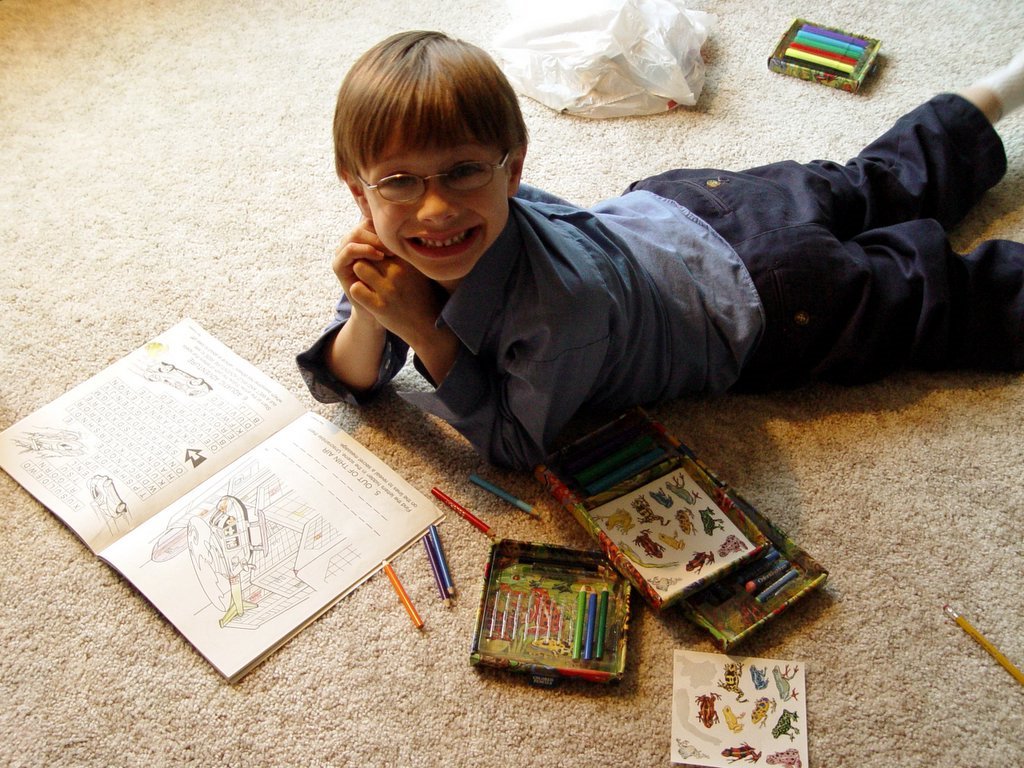
Oh, to be six again! Remember those days when paints, crayons, colored pencils, stickers, scissors, and glue provided you with hours of tranquility and fun? Life was good! Providing the ‘tools’ for a creativity is so important for children. Levi enjoyed a visit to our home recently. . .and we enjoyed observing the results of his efforts. It is always interesting to see how each child develops uniquely when it comes to creativity.
Is creativity something that can be taught? Each reader may respond to this differently, but most would generally agree that creativity comes from within and is a quality that is innately possessed at birth. Each child has potential, and if given the proper tools to develop it, wonderful, quirky, unique, and inventive works of art, song, or verse can result. Many years ago I read a book about growing creative children. I don’t remember the title or the author, but the principles were ones that became important in our homeschool. The writer suggested that the best tools for creativity were simple resources (paper, pen or pencil, keyboard, cardboard, glue, paint, crayons, glitter, feathers, sequins, crayons, etc.). It was her belief that there were always to be available to the child. She went on to say that the time and freedom to explore and create with these resources was key. This was not a subject taught in school, but rather an opportunity that took place during a child’s free time each day. When resources are available to the child, the creative activities they participate in become child-directed and meaningful to them. Exercises that involved coloring within the lines or copying existing art may assist the child in developing fine motor skills, but they do not foster creativity in a child. In the same way, a child who learns at an early age to think of their own sentence or story to write on a page, rather than assigned copywork that a teacher-parent chooses, learns not only to develop and improve their handwriting, but to become a thinker rather than a reflector of the assignments or thought of others. Why be satisfied with bringing a child up to grade level when he or she can reach for the height of imagination and artistic, musical, or written creativity?
This is a good time to review the Smithsonian Institute’s study of the factors that world-class geniuses experienced as they learned and developed their intellects. I believe that these factors not only develop great thinkers, but creative ones as well. Do you remember them from a previous post? The key factors are:
1) warm, loving, educationally responsive parents and other adults;
2) scant association outside the family, and
3) a great deal of creative freedom under parental guidance to explore their ideas.
Dr. Raymond Moore, in his book Better Late Than Early, makes a statement that ties this subject altogether for us. As the “grandfather of homeschooling”, I believe he was a very wise man. I love this quote from him:
“Children are happiest when they are busy, and keeping them busy should not be a matter of concern. Much of a child’s busyness will be accomplished on his own. Much of it will come from the child’s questions and curiosity. The parent’s goal should be to respond to the child’s questions in a patient, consistent and constructive way. Forget about the pressures of achieving. Cultivate the idea of being happily child centered, for the child is important. Take advantage of his motivation of the moment. Be happy that he is curious, and try to go along with his curiosities whenever you can” [page 21].2) scant association outside the family, and
3) a great deal of creative freedom under parental guidance to explore their ideas.
Dr. Raymond Moore, in his book Better Late Than Early, makes a statement that ties this subject altogether for us. As the “grandfather of homeschooling”, I believe he was a very wise man. I love this quote from him:
Give your child the resources he or she needs. They need the tools to create — free time, materials, and affirming support. Try to cultivate a child-centered approach. And take advantage of a child’s natural curiosity. Creativity is always sure to result when the formula is implemented. Allow the child to think outside of the box and stand-by to see the exciting results!
Labels:
creativity,
curiosity,
formula,
genius,
Moore Formula,
resources,
smithsonian formula
Subscribe to:
Posts (Atom)